How to Show Up in AI Search
The work is mostly about making the product easy to find, easy to understand, and easy to verify.
When someone asks an AI tool to compare software, the answer has to do three things before it can recommend a product: find the relevant pages, understand what the product does, and trust the evidence around it.
That is the useful way to think about showing up in AI search. It applies whether the product came from a traditional stack, a no-code tool, or an AI-assisted build.
Google’s guidance is straightforward: the fundamentals that help a page appear in regular Search still matter for AI Overviews and AI Mode. There is no special page length, hidden schema, or magic AI file that guarantees inclusion. OpenAI’s guidance is practical too: allow OAI-SearchBot to access the pages you want considered, keep useful information public, and make the site easy to understand.
The work is mostly about making the product easy to find, easy to understand, and easy to verify.
Start with the question, not your company name
“Does ChatGPT know my brand?” can be interesting, but it is not how most people choose a tool. They ask for help with a decision:
- What is the simplest project management app for a five-person remote team?
- Which invoicing tool works well for a freelancer who bills internationally?
- What is a good note-taking app with offline access?
- Which analytics tool is easiest to set up without a developer?
These questions reveal what the person is trying to decide. They also create something concrete to test.
Collect questions from sales calls, support messages, community discussions, and comparison searches. Run the same questions more than once and save the full responses. Look for the products mentioned, the descriptions used, and the pages cited.
A single response may be noise. A misunderstanding that keeps appearing is something worth fixing.
Make the page explain the product
The homepage still does more work than most teams expect. A visitor should understand five things quickly:
- who the product is for;
- what it helps them do;
- what happens after signup;
- what it costs;
- what it does not do.
“AI-powered productivity platform” sounds polished but does not give a reader much to hold on to. “Keep a five-person team’s tasks and deadlines in one place” is more specific. It tells the reader what the product does and who it is for.
Show the product before asking someone to create an account. A screenshot, sample result, or short demo usually explains more than another paragraph of feature copy. If the useful explanation is hidden behind a login, a new visitor and a crawler are both left to guess.
Make sure the page can be found
This is not the exciting part of the work, but it is where many “why is the product not showing up?” questions end.
The important page needs to be crawlable, indexable, and eligible to appear in regular search. Check that the key content is in the public page, internal links lead to it, and an accidental noindex or robots rule is not blocking access. Keep the main explanation publicly accessible, ideally in the initial HTML. Google can render JavaScript, but not all crawlers can. Don’t require a login to read it.
For Google’s AI features, the page still needs to meet the normal Search technical requirements. Google says there are no extra technical requirements for AI Overviews or AI Mode. For ChatGPT search, OpenAI says sites should allow OAI-SearchBot to access the content they want included.
That does not guarantee a mention. It means the page is available to be considered.
Give the answer somewhere to stand
A product page is one source. It is not the whole reputation of the product.
AI systems can also encounter documentation, directories, reviews, interviews, community discussions, customer stories, and comparison pages. These sources form the evidence around the product. The basic facts should line up across them: audience, use case, pricing, limits, and what the product actually does.
Three useful sources are more valuable than thirty thin mentions. A useful source might be:
- a walkthrough with real screenshots;
- a comparison that explains tradeoffs;
- a customer story with a specific problem and result;
- a directory listing that is complete and current;
- an article that teaches the reader something instead of asking for a link.
This is also where manufactured “AI mentions” fall apart. Google’s current guidance warns against inauthentic mentions. A pile of unrelated pages may look busy, but it does not give an answer engine a reliable reason to recommend the product.
Track the answer, not just the score
Showing up is not enough if the answer is wrong.
When reviewing an answer, check:
- did the product appear for the right use case?
- which competitors appeared beside it?
- how was the product described?
- which page or domain was cited?
- did the result change between providers or dates?
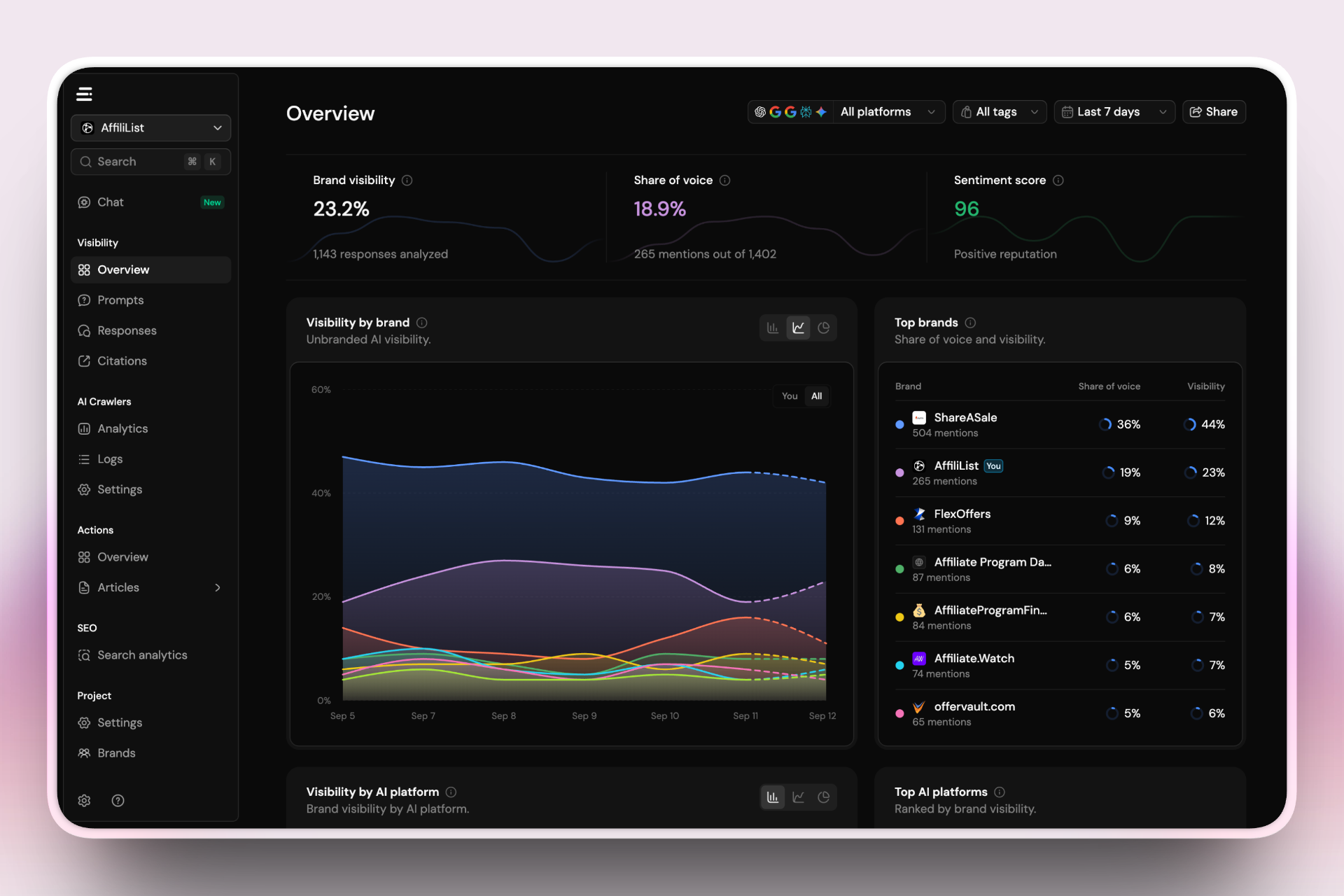
BeVisible, the tool I’m building, is designed around that workflow. It runs commercial prompts across ChatGPT, Gemini, Perplexity, Google AI Overviews, and AI Mode, then keeps the responses, mentions, competitor positions, and cited sources together. That supports a more useful follow-up than “what is our score?” The next question can be whether a page is unclear, whether a competitor has stronger proof, or whether the prompt is simply a poor fit.
The number is not a promise. The response and its sources are the things that can be acted on.
Fix one repeated problem
The fixes are usually smaller than the strategy decks suggest:
- replace a vague headline;
- correct an old price or feature;
- add the comparison people keep asking for;
- publish a missing example;
- update a stale directory profile;
- make a blocked page public;
- fix a page that an AI crawler keeps requesting and receiving an error from.
Make one change, then run the same prompts again. If the answer improves, keep the change. If nothing moves, look at the source or the question instead of producing another generic article.
Answers vary, so one strange result is not a reason to change the entire strategy. A result that appears once is a data point. A pattern across several runs is worth paying attention to.
That is the practical side of showing up in AI search. The product needs to be clear, the evidence needs to be real, and the answer needs to be checked often enough to notice when it drifts.
BeVisible exists to make that checking less manual. The goal is not to make an AI say something flattering. It is to give a product a fair chance of being found and described accurately when someone asks for help choosing a tool.