What Gets a Vibe-Coded App Rejected From a Launch Directory
Most launch directories will not tell you why they turned your product down.

Most launch directories will not tell you why they turned your product down. You get a line about quality standards, or nothing at all, and you are left guessing which part of the submission failed.
I run one, so I can just tell you. This is the actual rule set a submission passes through on Nick Launches, in the order it hits them, plus the reasons a human reviewer sends things back. Other directories differ in the details, but the shape is close to universal, and the failure modes for AI-built products are consistent enough that you can fix most of them in ten minutes.
One thing worth saying at the top, because it changes how you should read the rest: a rejection is not a ban. Every product that gets sent back can be edited and resubmitted. The system even emails you a week later to remind you.
There are two gates, and they fail differently
A submission passes an automated gate first, then a human one.
The automated gate is a schema check plus a duplicate check. It fails instantly, in the form, with a specific message. Nobody reads your product at this stage. The human gate happens afterward, in a review queue, and that is where judgment about the product itself gets applied.
Confusing the two is the most common mistake I see. A maker gets a validation error, assumes they were rejected on quality, and does not resubmit. They were never reviewed at all.
Gate one: the hard rules
These are fixed limits. There is no reviewer discretion, and hitting one is not a comment on your product.
Your name has a 40 character ceiling. Your tagline has 60. Your description has 600. If you paste in a paragraph your model wrote, it is almost certainly over 600 and will be refused.
You must upload a logo, and at least one screenshot. Five screenshots is the maximum. This one catches a lot of fast-shipped products, and it is the single most common thing I see missing.
You pick between one and three categories. Not zero, and a fourth will be dropped.
Your URL has to be a real HTTP or HTTPS address.
If you set a launch date it has to be between today and 90 days out.
There is also an optional target keyword field, and it accepts one keyword. Commas and quotation marks are rejected outright, because the field feeds the page title. People try to put a list in it. A list makes the page rank for nothing.
None of this is interesting, which is the point. It is the part you can clear before you ever get looked at, and clearing it costs you a few minutes of preparation rather than a week of waiting for a queue to tell you your tagline was too long.
Gate two: the duplicate check
This is where a surprising number of AI-built products get stopped, and where the logic is worth understanding because it is not obvious.
Every URL gets canonicalised before comparison. The scheme is dropped, the host is lowercased, a leading www is stripped, and the query string, the fragment and the trailing slash all go. What remains is host plus path. A second, weaker signal compares product names with everything except letters and numbers removed, which catches a resubmission where someone changed the URL slightly and kept the name.
Depending on what matches, a submission is allowed, redirected back to a draft you already started, blocked, or allowed through with a flag for the reviewer.
Two consequences matter for you.
First, adding a tracking parameter or changing a trailing slash does not create a new product. Makers try this when they want a second listing. It resolves to the same canonical URL.
Second, and more usefully: if you deployed on a shared host, a subdomain on Vercel, Netlify, Replit, Lovable, Bubble, Carrd, Framer, GitHub Pages or similar, you are not competing with every other tenant on that platform. Matching runs on the full canonical URL, path included, so your project on a shared domain is treated as distinct. Being on a free subdomain is not itself a problem here.
Relaunching your own product is a supported path rather than a duplicate. You pick a new week.
Gate three: what a human actually sends back
Once a submission clears the machine, a person opens it. The rejection email names four recurring reasons, and they are the reviewer's own wording rather than my summary of them: missing or low quality screenshots, an unclear value proposition, a broken or gated landing page, and a mismatch with the directory's maker tools focus.
Taking them in order, with what they actually mean in practice.
Missing or low quality screenshots. One screenshot satisfies the validator. It does not satisfy a reviewer. A screenshot of a logged out marketing page tells nobody what the product does. Show the interface doing the thing. If your product is a CLI, show a real session with real output.
Unclear value proposition. This is the one AI-assisted copy fails most reliably. Generated taglines converge on a register that sounds finished and communicates nothing: platforms that empower, solutions that streamline, tools that leverage. A reviewer reading sixty submissions cannot tell what your product does, so it goes back. The test is simple. Read your tagline and ask whether someone could name a competitor from it. If not, rewrite it as a verb and an object.
Broken or gated landing page. A reviewer opens your URL. If it presents a sign in wall, a waitlist form, or an empty state, they cannot evaluate anything. This is the most common failure specific to products built fast, because auth often ships before the marketing page does. If your landing page requires an account to see anything, you do not have a landing page yet.
Mismatch with the focus. Directories have a scope. Mine lists maker and developer tools. A submission outside that is not bad, it is in the wrong place, and this is worth checking before you spend the effort rather than after.
What a complete listing looks like
Here is a live one, chosen because you will recognise it.
Logo present. Tagline inside 60 characters and made of concrete verbs. A description that says who it is for and what happens, well inside the limit. Two screenshots of the actual interface rather than the marketing page. Categories, pricing model and builder attribution all filled in.
Nothing there is clever. It is just complete, and complete is most of what passing review means.
The other thing slowing you down is not review
Worth separating out, because makers routinely mistake it for rejection.
In one recent week, 238 products were submitted and 89 went live. That looks like a brutal acceptance rate. It is not one. The current week is reserved for paid placements, and only a fixed number of free slots open per week, so most of that gap is products correctly scheduled forward and waiting their turn. They were accepted. They have a date.
The practical version: submit two to three weeks before you need to be live. If you submit on Monday hoping to launch on Wednesday, the constraint you hit is the calendar, not the reviewer.
A checklist you can run before submitting
Name under 40 characters. Tagline under 60, containing a verb and a noun someone could search for. Description under 600.
A logo file, and at least two screenshots showing the product in use rather than the homepage.
A landing page that a stranger can understand without signing in.
One to three categories that genuinely fit, on a directory whose scope your product genuinely fits.
If you use the keyword field, one phrase, no commas.
Submitted early enough that your preferred week is still open.
That list is the whole thing. Most rejections are not quality judgments, they are incomplete submissions, and the difference between the two is about ten minutes of work.
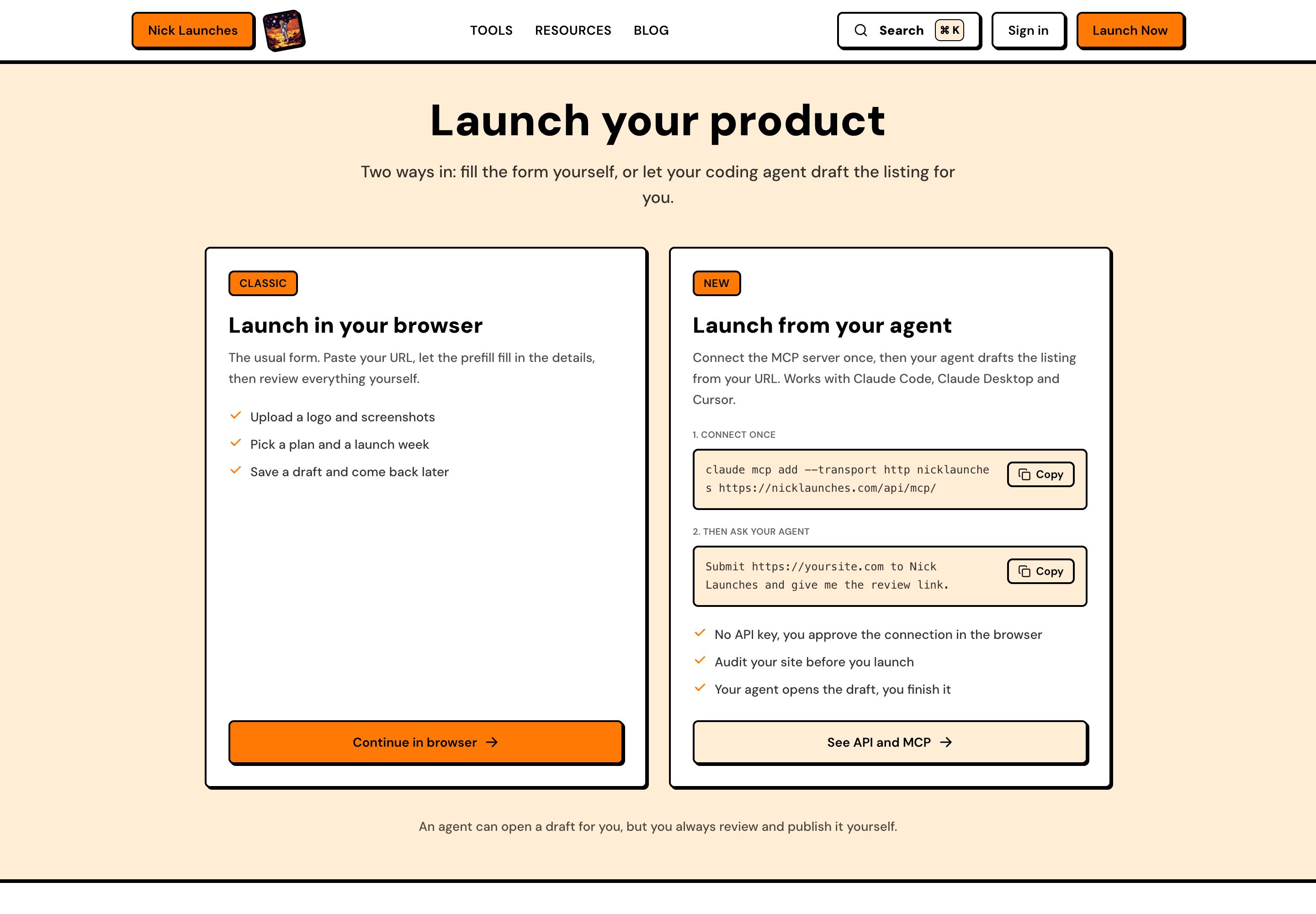
If you want to run it against a live directory, the submission flow on Nick Launches shows the same fields and limits described here, and you can save a draft without publishing to see what it asks for. Listing is free and the link is permanent, which is the trade Nick Launches makes with builders: a listing, a do-follow link, and discovery traffic in exchange for a submission that is actually finished.