Startup idea evidence scorecard
Review a startup idea with six manual evidence prompts. Keep unanswered questions visible, identify weak assumptions and export a practical next-action scorecard.
Find the assumption you need to test next.
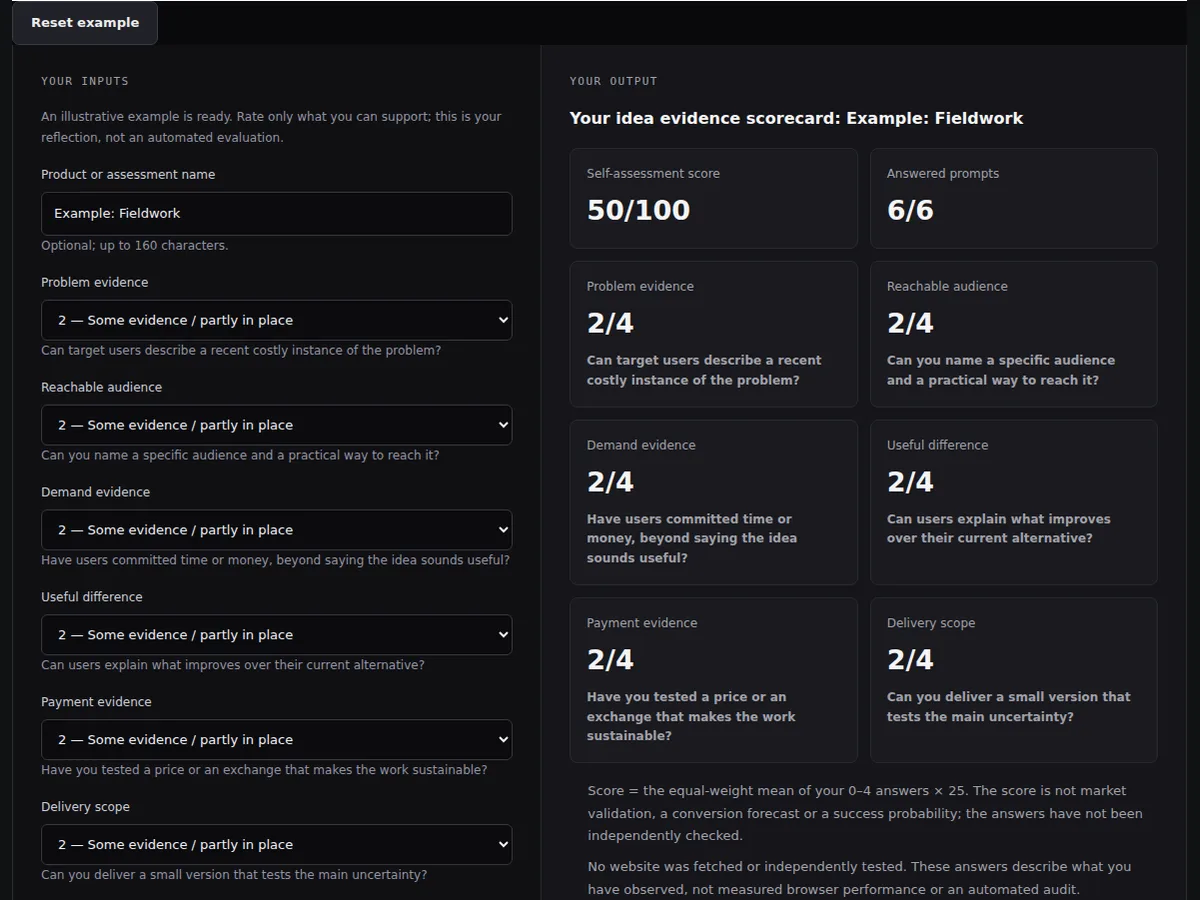
Reflect on the problem, audience, demand, useful difference, payment evidence and delivery scope behind a proposed product. The score summarizes only your entered answers. The useful output is a short list of actions that can turn a belief into something you have observed.
Free to use. No signup. Output: Manual evidence scorecard + next actions.
How to use Startup idea evidence scorecard
- Name the idea and read each evidence prompt before selecting a rating.
- Use Not checked yet for unanswered questions and rate the observations you can support.
- Review the weakest dimensions, choose a real research action and export the scorecard for follow-up.
Worked example: Find the missing commitment
These ratings are illustrative and manually supplied. They are not independently checked, market validation or a forecast that this idea will succeed.
- Example input
Problem 1; audience 2; demand 0; difference 3; payment 2; delivery 4, on the documented 0–4 scale.
- Expected output
Self-assessment: 50/100. Demand is the weakest entered dimension; the next action asks for a concrete trial or pilot commitment.
Questions, answered
Does AI or market research validate the idea?
No. This is a manual evidence self-assessment. It does not search markets, analyze competitors or verify your claims. A high self-rating cannot establish demand or success probability.
How is the score calculated?
When every prompt is answered, the equal-weight mean of your 0–4 ratings is multiplied by 25. If any prompt is not checked, the overall score stays incomplete while the next actions remain available.
What should I do with a weak dimension?
Use the suggested action to collect specific evidence, such as a recent user story or a concrete trial commitment. Revisit that answer after learning something; the score is a reflection aid, not a decision gate.
Keep building
Ready for feedback on your project?
Share what you are building with the VibeCodingList community.
Submit your project Explore projects